

Enhancing agricultural finance for rural development and climate resilience
Over the years, we have taken various approaches to delivering best practices in agricultural finance. In the following we present examples of collaborating with financial institutions in Eastern Africa, supporting agricultural advisory in Kyrgyzstan, organising study tours for Uzbekistan and creating saving groups in Madagascar.
Working in synergies with financial institutions
Smallholder farmers face significant challenges, making agriculture a risky business compared to other sectors. In addition to common risks like operational and financial setbacks, agriculture is also vulnerable to negative environmental and climate events which leads to increasing unpredictability. Consequently, many financial institutions are hesitant to lend to agricultural activities due to the high risks or lack of expertise.
To improve financial inclusion for smallholder farmers, GOPA AFC provides technical assistance to financial institutions. This includes developing agri-lending departments, creating new financial products, and evaluating existing services for the agricultural sector among others.
Aceli Africa aims to mobilise USD 1.6 billion in private lending for agricultural SMEs in Sub-Saharan Africa by 2030. It provides financial incentives to over 40 banks and finance companies to unlock lending to high-impact SMEs while strengthening lenders’ capacity. For instance, in collaboration with Tanzania Commercial Bank (TCB), GOPA AFC developed an agriculture finance strategy and business plan. With support from Aceli’s incentives and technical assistance, TCB now finances new value chains, such as cassava, boosting rural economies and regional food security. The AgFin strategy guides the choices of TCB which agri-value chains and value chain stages and actors to serve with which products; to that end a specialised “AgFin desk” was set up and staffed. Additionally, the "Agricultural Finance for Bankers" e-learning course has trained and certified 151 branch managers and loan officers, enhancing their ability to support agricultural lending.

A holistic approach on agricultural advisory in Kyrgyzstan
The "Value Chain Agro Finance" project in Kyrgyzstan project is co-funded by the European Union (EU), European Investment Bank (EIB), and the German Development Bank (KfW). We implement it in consortium with CAIConsulting, supported by the Ministry of Finance and the Ministry of Water Resources, Agriculture and Processing Industry of the Kyrgyz Republic.
In 2023, we began selecting primary production clusters with high development potential to establish support schemes. These schemes provide essential farm services, including input and credit supply, advisory services, and produce aggregation. Within these clusters, farmer or service provider organisations adopt these functions, continuing to offer services commercially through cooperatives, input suppliers, and companies that handle storage, processing, and marketing.
The project aims to enhance value chains for fruits and berries, cereals, vegetables, sugar, and potatoes. Central to our approach are Agricultural Advisory Schemes, coordinated by Kyrgyz advisory services (KGFRAS). The advisors monitor fields on a weekly basis to ensure that best agricultural practices are followed, such as appropriate fertilisation, timely pest control, and crop rotation. This leads to increased yields and improved produce quality within a year. Farmers are expected to boost their income from the target crops by at least 30-40%, ideally 50% or more, to afford these services. Initially, field advisors are subsidised, with a plan to phase out subsidies to ensure the project's sustainability.
We aim to expand our agricultural finance initiatives through tailored financial products and therefore reach more farmers. The disbursement of credit lines from the EIB and KfW will further enhance the positive impact. Our commitment to innovation and sustainable development remains strong as we strive to make a lasting impact.
For more insights, visit our project website or watch our videos about how we support the single value chains.
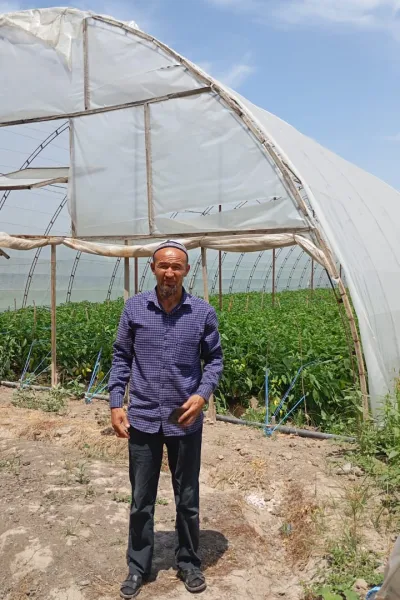
Study tours for Uzbekistan
International study tours are highly effective for capacity-building in agricultural projects. They provide participants with intensive learning experiences through visits to farms and agribusinesses, exposing them to advanced production methods. While these methods cannot always be directly implemented in their home countries, the tours inspire improvements in production and technology.
A recent study tour organised by the Horticulture Value Chain Promotion project took Uzbek berry farmers and stakeholders of the horticulture sector to Poland, a leading producer and exporter of berries. The tour addressed labour challenges in berry production by showcasing advanced harvesting equipment. Participants visited berry farms, equipment manufacturers, and processing facilities, learning about the full production cycle from seedlings to retail packaging. B2B meetings allowed Uzbek businessmen to establish contacts with Polish companies offering high-quality seedlings and sorting and packing lines, fostering potential business relationships and technology transfer.
The full impact of the study tour will be realised through follow-up support and dissemination of results within the horticulture community. This includes introducing new berry varieties, improving production methods, testing innovative equipment, and investing in post-harvest processes and marketing. We assist farmers intensifying contacts with potential foreign partners and facilitating financing for equipment and seedlings. Training on demonstration plots will transfer knowledge to other farmers, creating a multiplier effect. By November 2024, after 15 months of our support, over 1,100 farmers, have been trained in Farmers Field Schools, in almost all regions of Uzbekistan.

Savings groups in Madagascar
Climate change impacts are increasingly evident worldwide, necessitating urgent action from governments, international organisations, and civil society. Beyond policies, tangible actions are required. GOPA AFC contributes to this goal through various projects, including the GIZ project "Adaptation of Agriculture Value Chains to Climate Change" (PrAda 2). This project offers concrete solutions for vulnerable populations, such as farmers in Southern Madagascar, by developing Village Savings and Loan Associations (VSLA).
A VSLA is an informal savings model for groups of 10 to 25 people in marginalised communities, often where financial access is limited. Members elect a president, secretary, and treasurer, and savings are securely stored in a box with keys held by three different individuals to prevent fraud. The savings are divided into two boxes - one for redistribution at the end of a 9-month cycle and another for social activities decided collectively by the group.
In the first year, our local team helped create 60 VSLAs, reaching over 1,400 people in Southern Madagascar. This model enhances financial access and inclusion for marginalised communities and enables them toto save together for important seasonal or acute household events. Additionally, VSLAs foster community solidarity and collective decision-making, and shared funds support members during key life events, decided unanimously.
For more information, please contact: agnieszka.windel [at] gopa-afc.de (agnieszka[dot]windel[at]gopa-afc[dot]de,) benedetta.ferraro [at] gopa-afc.de (benedetta[dot]ferraro[at]gopa-afc[dot]de,) mareike.decker [at] gopa-afc.de (mareike[dot]decker[at]gopa-afc[dot]de)
Related Articles

Business Acceleration Clinic: Turning Market Exposure into Market Access for Green Women-Led MSEs in Uganda
The WEEG-UWEP initiative supported women entrepreneurs' participation in Jinja's 2026 National Agricultural Trade Show.

Pakistan: SEW-II Project Launch
Expanding essential health services in underserved communities

EU GI Products Shine at SIAL Shanghai 2026
Key EU GI booth supported by the Asia Partnerships Facility

Supporting the Diversification of Tunisian Tourism
Highlighting Geoparks, Design Hubs & Restored Landmark Initiatives in Tunisia

Women-led Businesses in Uganda Taking the Next Step
WEEG-UWEP project supports micro and small enterprises

Behavioural Science in Communication: Training the InformEU Network
Behavioural science is not a nice-to-have in communication. It is the missing link between a well-crafted message and real social ...