Flagship project
Building Bridges Between Schools and Businesses
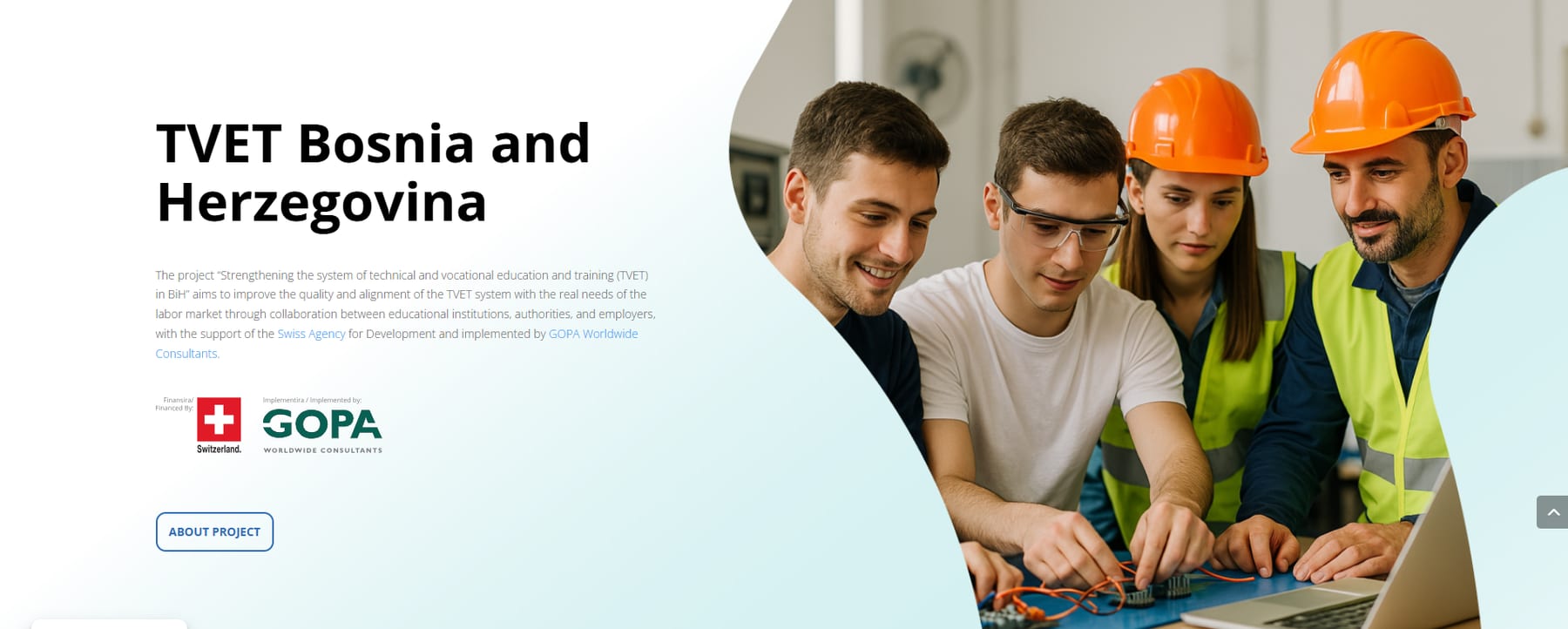
The Project is transforming vocational education and training in Bosnia and Herzegovina into a shared skills and competitiveness agenda, bringing education authorities, schools and employers together to develop market-relevant skills, improve work-based learning and strengthen the institutional foundations for productivity, employability and sustainable economic growth.
The challenge
Vocational education and training in Bosnia and Herzegovina operated in a context marked by fragmented governance, weak institutional coordination, limited public-private dialogue and the absence of harmonised evidence for policy making. Education authorities, employers and schools lacked structured channels through which to agree on the skills the labour market actually needs.
Our goal
The overall goal of the project is to improve and strengthen the coordinated TVET governance framework in Bosnia and Herzegovina in line with evidence-based policymaking and quality assurance principles. By strengthening coordination among education authorities, businesses and schools, the Project supports a more responsive skills system that better reflects labour-market needs and contributes to improved employability and private-sector competitiveness.
Our approach
The Project applies a systemic, demand-driven and modular approach. Through the Modular Reform Adoption Scheme, institutions adopt and sequence reforms according to their mandates, capacities and commitment, rather than applying a uniform model across Bosnia and Herzegovina. The approach combines structured public–private dialogue, regulatory support, institutional capacity development and labour-market evidence. Employers participate in identifying skills needs, shaping occupational standards and strengthening work-based learning. In this way, education becomes a bridge between workforce development and private-sector competitiveness.
Impact in numbers
A key systemic achievement was the consolidation of legitimate and functional governance mechanisms capable of anchoring TVET reform beyond individual institutions and project structures. The TVET Advisory Board and Business Council have evolved into recognised coordination platforms, improving transparency, clarifying roles and responsibilities, strengthening ownership and reducing reliance on informal coordination. Legislative and regulatory reform advanced significantly, with support for TVET laws, bylaws and policy proposals addressing governance, work-based learning, quality assurance, company accreditation, student status during work-based learning and TVET financing.
Key highlights
- Stronger governance and policy reform: the TVET Advisory Board and Business Council have established structured cooperation between education authorities, employers, chambers, schools and social partners, contributing to new laws, bylaws and policy initiatives
- A stronger voice for business: employers now contribute to skills planning, occupational standards, training programmes and work-based learning, helping education respond more effectively to economic demand
- Evidence for better decisions: the TVET Barometer, the Work-Based Learning Cost-Benefit Analysis and a digital WBL platform provide new evidence and infrastructure for policy, financing and investment decisions
- Quality from the system to the school and workplace: EQAVET-based self-assessment, school TVET councils and certified company mentors are strengthening the quality and relevance of vocational education and workplace training
- The established partnerships, institutional knowledge, dialogue structures and evidence-based tools strengthen Bosnia and Herzegovina's institutional readiness and alignment with European standards, supporting the country's EU accession process
Voices from the field
This is an opportunity to look at the results we have achieved and, together with employers, to assess the needs of the labor market and try to improve the dialogue between education and the labor market.
Education, for me, equals our future. Regardless of whether our children stay here or go abroad to work, it is extremely important that they have good education, because that determines their future. We, as employers, must do everything to create conditions for them to stay here.
Watch the interview
It is clear that we need changes to strengthen our economy and make it more resilient to challenges. The education sector and the economy must be better connected, and our partners from Switzerland, Austria, and Germany will help us in this.
Success story
A school joins a broader reform movement
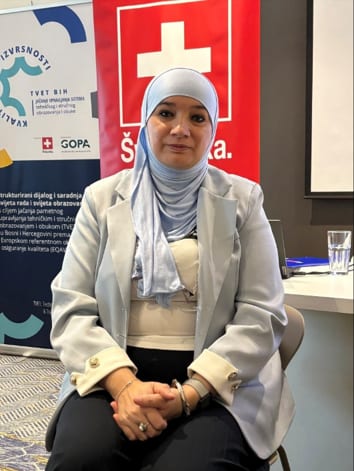
For Mirela Okerić-Čorbo, Director of the School for Environment and Wood Design in Sarajevo, participation in the third workshop organised by the Ministry of Education was more than just professional training. It was a milestone for her school. She proudly notes that her school was nominated to take part, alongside two schools from each canton, creating a unique platform for exchange and learning.
Mirela explains that the workshop introduced advanced tools and approaches that will significantly improve the way schools operate. The focus on advisory councils was particularly relevant: while her school had an informal council, the workshop highlighted the importance of formalising this structure to ensure legal recognition and sustainability.
Through this experience, Mirela and her colleagues gained not only new knowledge but also a sense of belonging to a broader reform movement. Her story illustrates how the project empowers schools to strengthen governance, embed quality assurance, and create better conditions for both teachers and students.
We are now part of an upgraded system of work that will certainly help our school and enhance everything we have done so far.
Mirela Okerić-Čorbo · Director, School for Environment and Wood Design, Sarajevo
Impressions