
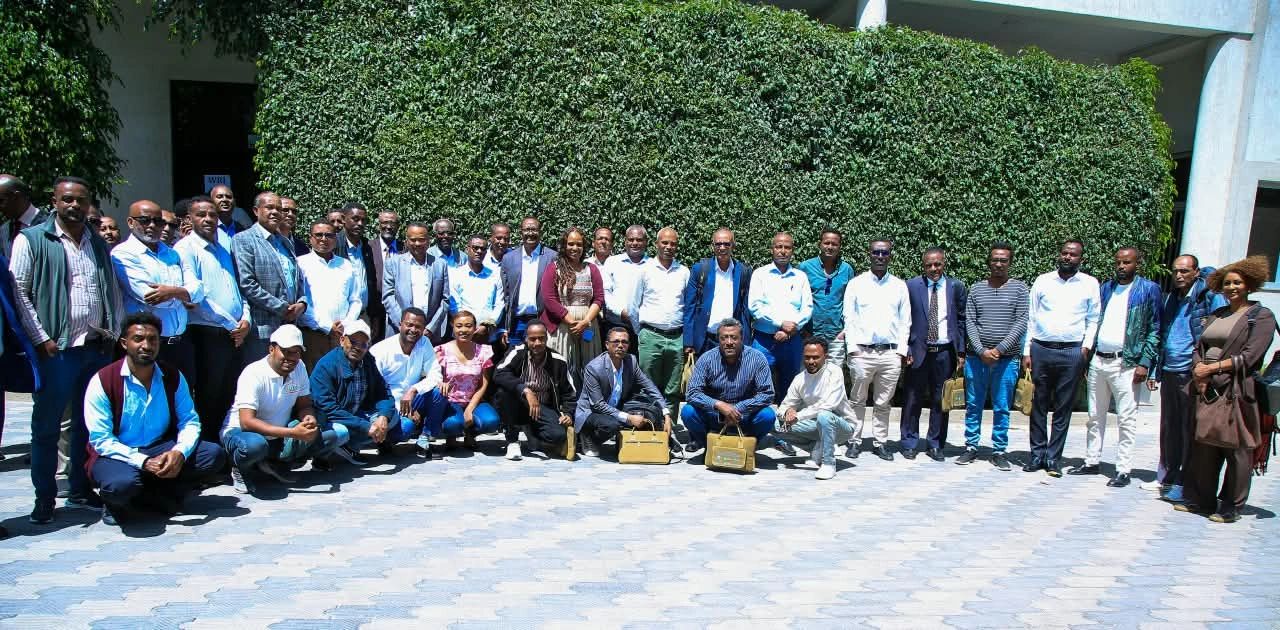
Un événement national sur « Faire progresser l’agriculture régénératrice pour des systèmes alimentaires inclusifs, des sols sains et la résilience climatique en Éthiopie » s’est tenu à Adama du 8 au 9 octobre. Organisé par FOLU, SAA et SWR à la suite de l’élaboration et du lancement de la Stratégie nationale d’agriculture régénératrice de l’Éthiopie. L’événement a réuni des institutions gouvernementales, des ONG, des acteurs du secteur privé, des chercheurs, des partenaires au développement et des praticiens pour discuter de la manière dont l’agriculture régénératrice peut passer de la stratégie à la mise en œuvre pratique à travers le pays.
La nature gagne toujours : l'agriculture régénératrice en Éthiopie
GOPA Pro a contribué aux discussions nationales sur l'avancement de l'agriculture régénératrice en Éthiopie, en partageant des approches pratiques pour améliorer la santé des sols, la productivité agricole et la résilience climatique. L'événement a mis en lumière le potentiel des engrais organiques et des pratiques agricoles durables pour renforcer la sécurité alimentaire et les moyens de subsistance des petits exploitants.
Le défi
Ethiopia has a long and rich agricultural history and is known as a center of origin and diversity for important crops such as coffee, teff, enset, sorghum, finger millet, noug, pulses, and oilseeds. Agriculture remains the backbone of the national economy, supporting the livelihoods of millions of smallholder farmers, contributing significantly to GDP, generating export earnings, and providing food, employment, and raw materials for agro-industries. Despite its importance, the sector faces serious challenges, including climate change, land degradation, declining soil fertility, biodiversity loss, limited irrigation, weak market linkages, high input costs, postharvest losses, and institutional coordination gaps.
Notre objectif
A key takeaway from the conference was the strong alignment between GOPA Pro’s activities, the principles of regenerative agriculture, and Ethiopia’s National Regenerative Agriculture Strategy. The event created space to showcase practical field experience, strengthen partnerships, and open doors for future collaboration. Overall, regenerative agriculture provides Ethiopia with a strategic pathway to restore soil, water, and biodiversity while improving productivity, livelihoods, and climate resilience. With strong coordination, investment, research, extension support, and private-sector engagement, it can play a major role in transforming Ethiopia’s agriculture into a more resilient, inclusive, and sustainable system. GOPA Pro is inviting all regenerative agriculture actors to collaborate for effective and sustainable solutions for farming communities.
Notre approche
Regenerative Agriculture in Ethiopia offers a timely and practical response to these challenges. It promotes farming systems that restore soil health, improve water management, enhance biodiversity, increase productivity, and strengthen climate resilience. This approach is especially relevant in areas affected by soil erosion, nutrient depletion, soil acidity, moisture stress, and dependence on rain-fed agriculture. Practices such as composting, manure application, biofertilizers, crop rotation, intercropping, agroforestry, reduced tillage, residue management, integrated crop-livestock systems, water harvesting, and rangeland restoration can help rebuild the natural resource base while improving farmers’ income and food security.
During the conference, the Ministry of Agriculture presented the National Regenerative Agriculture Strategy, followed by discussions on how to support implementation at field level. Participants noted that many organizations are already promoting regenerative agriculture practices in different parts of the country, but that stronger collaboration, coordination, evidence generation, and scaling mechanisms are needed. Research papers related to regenerative agriculture were also presented and reviewed by invited experts, while private-sector actors shared their contributions and experiences. There was also an exhibition at the conference where private-sector companies producing organic fertilisers introduced their products.
GOPA Pro was among the private-sector organizations invited to present its work. The company shared its experience in promoting organic fertilizers, particularly vermicomposting and homemade liquid biofertilizer. Special attention was given to homemade liquid biofertilizer because it is unique, affordable, easy to prepare, environmentally friendly, and well aligned with regenerative agriculture principles. Field experience has shown a yield advantage of 45–65% compared with farmers’ traditional practices, making it a promising option for smallholder farmers.
The event also provided an opportunity to call for stronger collaboration among regenerative agriculture actors. GOPA Pro encouraged partners to consider homemade liquid bio-fertilizer as an important organic fertilizer option alongside commercial liquid fertilizers. The company expressed its readiness to support both governmental and non-governmental organizations, private companies, and community-based initiatives in promoting, and scaling this technology for the benefit of farming communities.